

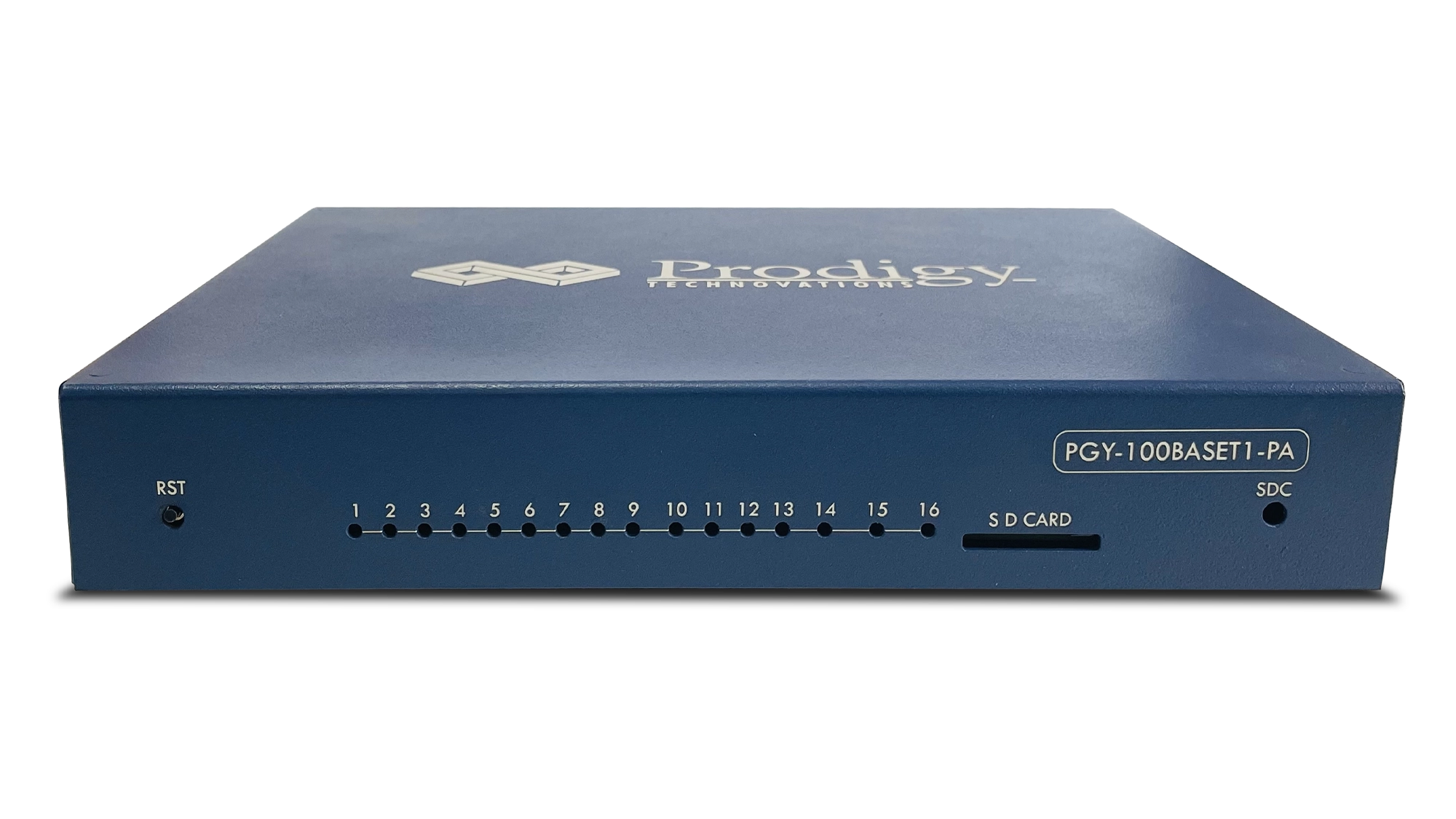
100BASE-T1 Automotive Ethernet Protocol Analyzer is the Protocol Analyzer with multiple features to capture and debug communication between the host and design under test. Automotive Ethernet interface scales up to address current and future needs of in-vehicle bus speed requirements. The need for higher-speed in-vehicle buses is increasing to support feature-rich ADAS and connected vehicle needs. Two-wire full-duplex 100BASE-T1 PAM 3 signaling is the choice of interface bus to address these needs.
Prodigy Technovations 100BASE-T1 Automotive Ethernet Protocol Analyzer provides an industry-first solution for the non-intrusively passive tap of the 100BASE-T1 bus at the physical layer and ensures no latency and accurate capturing of protocol data. Powerful basic and multi-level layer 2 to layer 7 protocol trigger capabilities enables the design engineer to capture protocol activity at a specific event. PGY-100BASE-T1-PA supports continuous streaming of captured protocol data to host computer SSD/HDD enabling long-duration capture.
Core Queries
Frequently Asked Questions
Core Queries
Frequently Asked Questions
You can purchase Prodigy Technovations solutions by submitting a Request a Quote on our website or by emailing us at contact@prodigytechno.com. Based on your requirements – such as protocol, data rates, and validation stage – our team will recommend the appropriate analyzer, exerciser, or electrical validation solution along with the required configuration.
Prodigy supports a broad range of serial bus and high-speed interfaces used in semiconductor and embedded systems. These include PCIe, UFS, I3C, eMMC, SD, SPI, QSPI, UART, and other serial interfaces. In addition, our tools support application and management layer protocols such as MCTP, SPDM, NVMe-MI, and PLDM over I3C, enabling full-stack validation.
Yes. Prodigy offers evaluation programs where engineers can test the tools in real validation environments. This includes use cases such as protocol decoding, traffic generation, error injection, and conformance testing. Evaluations are guided by our technical team to ensure your specific validation challenges are addressed.
Yes. Prodigy tools provide Python-based APIs and automation capabilities that enable repeatable validation workflows. Engineers can implement regression testing, automated traffic generation, protocol conformance checks, and long-duration stress testing as part of their validation pipelines.
Yes. Prodigy offers oscilloscope-based protocol decode and electrical validation software, allowing correlation between physical layer signal behavior and protocol-level events. This is critical for debugging signal integrity issues, timing violations, and link stability in high-speed interfaces.
Prodigy solutions support the complete validation lifecycle including IP design validation, protocol emulation, silicon validation, conformance testing, and system-level debug. These tools are widely used for interoperability testing, error injection, and corner-case validation across semiconductor, storage, automotive, and data center applications.